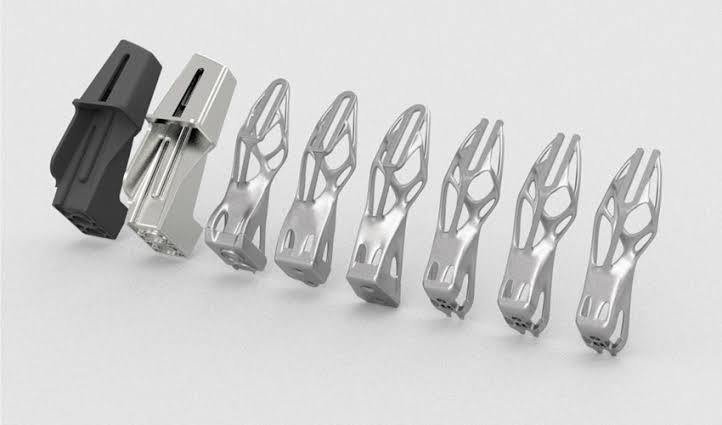
Topology Optimization in Practice: From Wheel Uprights to Spaceframe Monocoques
Executive Summary
Topology optimization is often celebrated for its ability to produce striking, organic geometries. However, in high-performance automotive and motorsport engineering, it serves a far more pragmatic purpose: systematically solving complex multi-load trade-offs. By examining two real-world application examples—an electric sports car wheel upright and a single-seater monocoque chassis—we explore both the practical engineering workflow and the broader philosophical shifts this technology enables.
1. Case Study 1: The Electric Sports Car Upright
A suspension upright is a quintessential multi-load component. It operates within tight spatial boundaries while simultaneously transmitting diverse, high-magnitude forces from the tire patch to the chassis.
In this application (given to my students as an exercise), the topology optimization process evaluates four critical operational load cases:
- Bump: Peak vertical impact loading.
- Acceleration: Longitudinal tractive forces.
- Braking: Severe longitudinal deceleration torque and forces.
- Outer Cornering: High lateral cornering loads transferring weight to the outer wheel.
Although simplified to four primary conditions, these load cases effectively demonstrate how conflicting force vectors demand material presence in vastly different structural paths.
The Three-Stage Structural Evolution
- Design Space Definition: The initial volume is strictly bounded by the interior envelope of the wheel rim, brake caliper packaging, and suspension hardpoint locations.
- Optimizer Material Distribution: The density-based algorithm strips unnecessary mass, revealing the underlying load-carrying skeleton.
- Surface Extraction & Smoothing: Raw density isosurfaces are extracted. Because solver outputs contain local geometric artifacts and non-manufacturable features, engineers must redesign and smooth these surfaces before subjecting the final geometry to a mandatory validation FEA check prior to manufacturing release.

2. Case Study 2: Torsional Stiffness of a Monocoque & The Spaceframe Revival
As presented in Computational Structural Engineering, applying topology optimization to optimize the global torsional stiffness of a single-seater race car monocoque yields a profound structural insight: the algorithm naturally converges toward a classical truss-like (spaceframe) architecture.
This result mirrors the historic race car chassis designs of past decades, where triangulated tubular frames efficiently carried primary torsional and bending loads.
A Paradigm Shift in Sustainable Manufacturing: As large-format metal Additive Manufacturing (3D printing) advances, this computational insight invites designers to rethink modern chassis philosophy. Combining topology optimization with large-scale metal printing could enable a return to highly optimized aluminum spaceframe constructions—offering an efficient, structural, and far more sustainable alternative to energy-intensive, difficult-to-recycle composite monocoques.

3. The Engineer’s Role: Bridge Between Algorithm and Production
Whether designing a suspension upright or an entire vehicle chassis, topology optimization outputs must never be treated as final CAD files. The algorithm provides the optimal material path; the structural engineer provides the manufacturability, fatigue resistance, and final sign-off.
A rigorous engineering workflow requires:
- Interpreting density plots to understand primary stress flows.
- Re-modeling organic shapes into manufacturable CAD geometries (casting, 5-axis milling, or 3D printing).
- Performing secondary linear and non-linear stress analyses to account for stress concentrations, buckling, and fatigue.
4. Conclusion
Topology optimization is not merely an automated design generator—it is a powerful guide that challenges engineering conventions and opens new horizons for lightweight, sustainable design.
For a deeper exploration into practical structural calculation methodologies and real-world FEA application strategies, explore my book Computational Structural Engineering.
More on Topology Optimization can be found in this Case History.
